
P4_PCXI Physical Context Interaction Viewpoint
| Domain | Aspect | Maturity |
|---|---|---|
| Physical | Interaction & Collaboration |  under construction |
Example
Purpose
The P4_PCXI Physical Context Interaction Viewpoint supports the specification of sequences of interactions between the physical system and physical external systems across physical connections.
It captures interaction behaviour that is relevant to the physical realization of the system, particularly where it results from physical or technical architectural decisions, such as initialization, handshaking, synchronization, startup, shutdown or recovery.
The viewpoint provides a means to specify the ordering and temporal characteristics of exchanges of information, signals, energy, material or mechanical quantities across physical interfaces.
The viewpoint complements the conceptual System Context Interaction Viewpoint by capturing interaction behaviour that is specific to, or relevant because of, the physical realization of the system
Applicability
The Physical Context Interaction Viewpoint supports the “create system design” activity part of the “Design Definition Process” activities of the INCOSE SYSTEMS ENGINEERING HANDBOOK 2023 [§2.3.5.5] and contributes to the artifacts “System Design Description” and “System Interface Definition”.
Furthermore, the viewpoint supports the “Interface Management” approach of the INCOSE SYSTEMS ENGINEERING HANDBOOK 2023 [§3.2.4].
Presentation
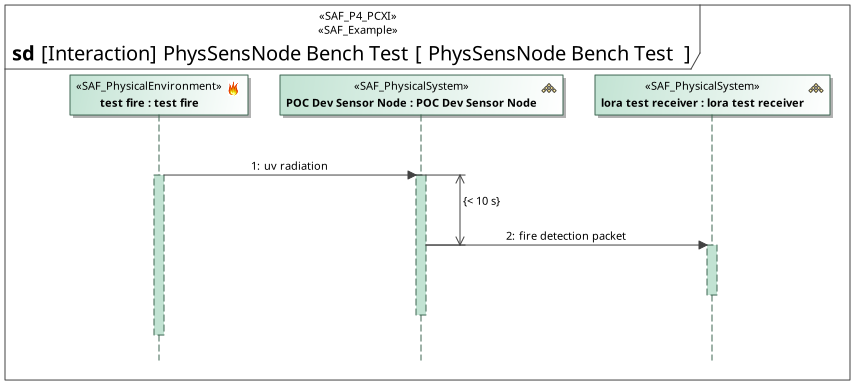
The P4_PCXI Physical Context Interaction Viewpoint is represented by a sequence diagram showing exchanges between the physical system and physical external systems through physical connections.
The sequence may represent ordering, timing, duration, periodicity, synchronization and temporal constraints of exchanges.
The lifelines representatives are SAF_PhysicalContextRole or SAF_PhysicalContextRole_SoI elements.
Stakeholder
- Acquirer
- Customer
- Hardware Developer
- IV&V Engineer
- Operator
- Safety Expert
- Security Expert
- Software Developer
- System Architect
- User
Concern
Profile Model Reference
The following Stereotypes / Model Elements are used in the Viewpoint: